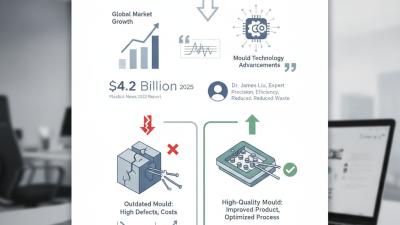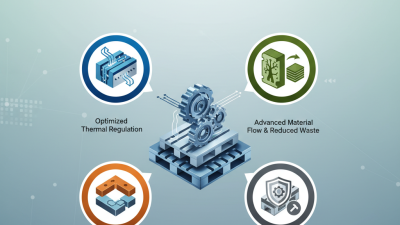
Choosing the best Parts Bin Mold manufacturer in China requires more than comparing online prices. The right partner should understand product use, material behavior, mold life, and production risk. A parts bin may look simple, yet its walls, ribs, stacking edges, and hanging features demand careful engineering. Small errors can cause poor stacking or difficult ejection. The best manufacturer turns these details into stable, repeatable production.
A serious evaluation should examine design support from the first drawing. Look for practical DFM feedback, suitable steel selection, balanced cooling, and controlled gate placement. For PP or ABS bins, shrinkage must be considered before machining begins. Ask for cavity layouts, mold-flow analysis, dimensional reports, and sample approval records. Strong suppliers also explain maintenance schedules clearly. This builds confidence beyond attractive promises.
Factory experience matters. Inspectors should check critical dimensions with calibrated tools, while technicians monitor polishing, venting, and mold alignment. A dependable company should provide clear communication, realistic lead times, and traceable quality records. Certifications can support credibility, but documents alone cannot prove workmanship. Request photos, trial samples, and references for similar storage products. No supplier is perfect. A low quote may hide weaker steel or limited after-sales support. It is easy to overvalue speed. A thoughtful buyer should also question assumptions, including whether the selected design suits actual warehouse handling. The best choice is the manufacturer that combines technical skill, honest communication, and consistent performance over many production cycles.
What Is the Best Parts Bin Mold Manufacturer in China?
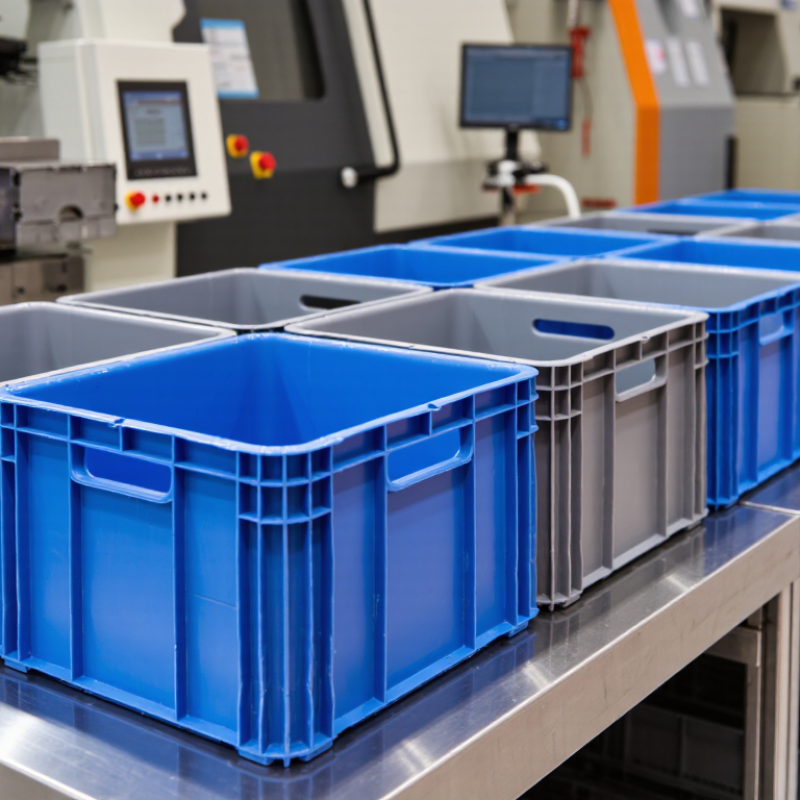
The best parts bin mold manufacturer is defined by consistent engineering, not impressive promises. Experienced mold engineers study the bin’s load, wall thickness, stacking method, and working environment before cutting steel. They should understand how polypropylene or ABS behaves during injection molding. Small design choices matter. A sharp internal corner may create stress, while uneven walls can cause warping.
Reliable manufacturers use suitable mold steel, controlled machining, and documented inspection procedures. Ask for dimensional reports, trial samples, and cavity balance records. A practical supplier will check whether bins release smoothly without damaging edges. They will also test stacking strength, handle performance, and repeated use. Clear communication is essential. Drawings, tolerances, resin requirements, and delivery dates should be confirmed in writing.
No factory is flawless. That matters. A manufacturer that openly discusses trial failures often inspires more confidence than one claiming perfect results. During my own supplier evaluations, delayed feedback usually revealed deeper project risks. A capable team should explain corrective actions, not hide them. Mold maintenance also deserves attention, including cleaning plans, spare parts, and repair response. The lowest quotation may exclude these costs. Careful buyers compare mold life, production stability, inspection quality, and after-sales support. Good judgment comes from evidence, factory experience, and a willingness to question attractive but incomplete answers.
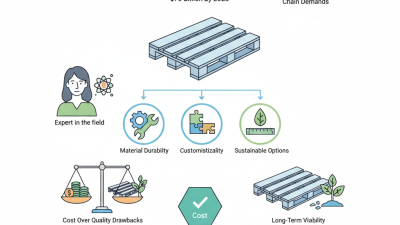
Choosing the best parts bin mold manufacturer in China requires more than checking surface polish. ISO 9001 is a process-control framework, not a guarantee of flawless cavities. The 2022 ISO Survey recorded about 1.26 million ISO 9001 certificates worldwide, showing its broad adoption. During an audit, buyers should review controlled drawings, steel certificates, calibration records, revision history, and corrective-action evidence. Ask for a sample CMM report. A certificate alone proves little.
IATF 16949 adds stricter automotive controls. It connects moldmaking with risk analysis, special characteristics, process capability, measurement-system analysis, and supplier management. A capable manufacturer should explain how cavity balance, cooling performance, venting, and shrinkage risks are validated. PPAP documents can show whether the mold supports repeatable production, not just an attractive first sample. Industry quality reports repeatedly identify traceability and supplier control as major sources of preventable variation.
Look closely at production evidence. Can the toolroom link each electrode, insert, and heat-treatment record to one mold number? Are corrective actions closed with measured results? Does the CMM report match the latest drawing revision? IATF certification improves confidence, but audits use sampling. A certified system can still miss flash on a difficult rib. That is the uncomfortable part. Buyers should combine certificates with trial-shot videos, dimensional data, maintenance plans, and direct technical questions. Certification supports trust; demonstrated process capability earns it.
For a 500,000-cycle target, steel selection needs more than a catalog comparison. P20 and 1.2311 are practical choices for standard polypropylene or HDPE parts bins. Both are pre-hardened mold steels with good machinability and acceptable polishability. In many projects, they deliver reliable performance when cooling is balanced and ejector alignment is controlled.
H13 becomes more attractive when the resin contains glass fiber, mineral filler, or abrasive additives. Its stronger wear resistance and thermal stability can protect cavity edges, gates, and slider surfaces. However, H13 usually costs more and requires disciplined heat treatment. A poorly treated H13 mold can underperform a carefully finished P20 mold. That detail is easy to overlook. Steel grade alone does not guarantee 500,000 cycles.
Tips: Ask the manufacturer for the steel mill certificate, hardness report, and heat-treatment records. Check whether the cavity steel matches the expected resin and cycle speed. During trials, inspect gate erosion, parting-line flash, ejector marks, and cooling consistency after repeated shots. A mold shop with real production experience should explain these findings clearly, not promise a fixed lifetime without conditions. For ordinary bins, 1.2311 or P20 may be sufficient. For abrasive materials or demanding production schedules, H13 may justify its added cost. Even then, I would review maintenance intervals again; the first estimate is not always correct.
For most injection-molded parts bins, ±0.05 mm cavity tolerance is technically achievable. However, it does not automatically guarantee accurate finished dimensions. Mold steel movement, resin shrinkage, cooling imbalance, and machine variation can change the result. In practical mold trials, I would verify critical dimensions with a calibrated CMM, not visual inspection alone. ISO 286-1 provides the tolerance framework, while ISO 21920 supports clearer surface-texture evaluation.
An Ra 1.6 μm finish can suit smooth bin walls, sliding lids, and visible handling surfaces. It may also reduce unwanted material drag during ejection. Yet, surface roughness is not the only concern. Draft angles, corner radii, weld lines, and polishing direction affect release and appearance. Small changes matter. A poorly vented cavity can still create burns, even with excellent polishing.
Industry demand supports careful process control. Plastics Europe reported global plastics production of 413.8 million tonnes in 2023. Grand View Research also valued the global injection molding market at approximately USD 42.9 billion in 2023. These figures show scale, but they do not prove every supplier can hold tight specifications. My practical view is cautious: request a DFM review, steel certification, trial samples, CMM results, and a documented Ra reading. A ±0.05 mm promise without measurement records is only a promise.
Choosing a parts bin mold manufacturer in China requires more than comparing hourly rates. A capable supplier should provide a practical DFM review before machining begins. The review should cover wall thickness, draft angles, ribs, gates, ejection marks, and likely warpage. Ask for marked-up 3D files, not vague approval emails. Small changes to a bin’s corner radius can improve filling and reduce later polishing.
T1 trials reveal the manufacturer’s real process control. Request trial parts, injection parameters, dimensional reports, and photographs of the mold surface. Check stackability, lid fit, part weight, and visible weld lines. A supplier may show attractive samples, yet overlook a weak ejector pin area. That happened on a previous project. The second trial needed steel modification, costing both time and confidence. Allow room for correction.
Lead time should be divided into design, steel preparation, machining, assembly, T1, and revisions. A promise of 35 days means little without these milestones. Warranty terms also need measurable language. Confirm coverage for flash, cracks, cooling leaks, premature wear, and repeated dimensional failure. Clarify repair labor, replacement components, shipping responsibility, and response time. Twelve months sounds reassuring. It may not cover production volume or poor maintenance. A reliable manufacturer records assumptions in writing and accepts reasonable technical questions without defensiveness.